
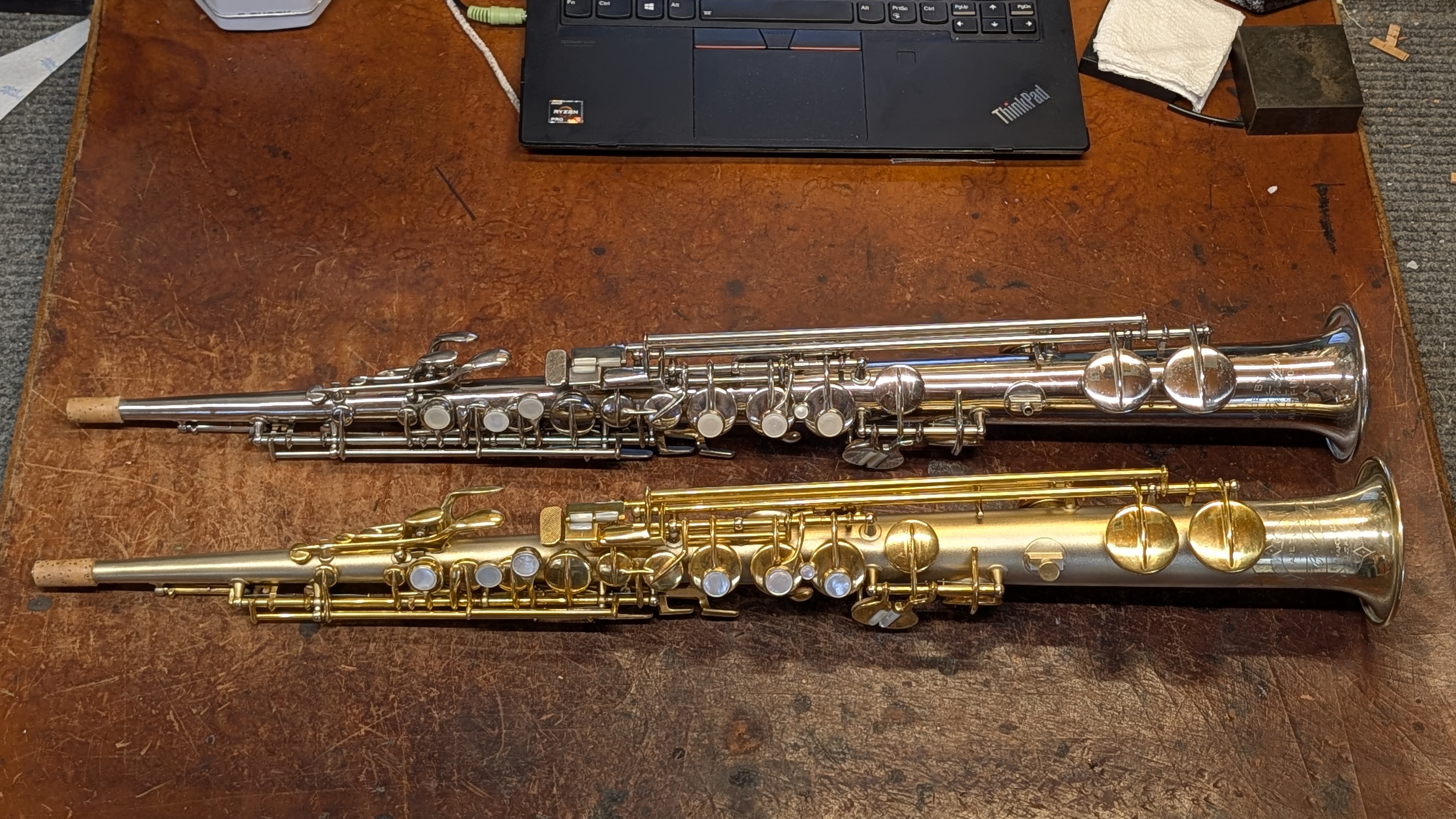
The Conn 18M was one of the outputs of the Conn Experimental Laboratory around the same time as the Conn-O-Sax and the F Mezzo-Soprano. The stretch was supposed to be part of Conn’s 1920s major upgrades across the saxophone spectrum, but ended up being part of their failed/abandoned cadre of great but weird horns that include the F-mezzo and Conn-O-Sax. They were made starting in 1928 and quietly and quickly faded out- probably within two years, although as is the case with other horns that fail to sell they trickled out over time long after they ceased production. The “stretch” was as it sounds: longer and skinnier than a normal soprano, with a redesigned bore and scale and keywork aimed at improving both tone and intonation and facility- something they very much achieved, IF you have the right mouthpiece.
Much less known than its siblings, it similarly could not find a foothold in the market and faded into obscurity- obscurity even greater than the Conn-O-Sax and F Mezzo! Likely because it is visually not super distinct from a regular Bb soprano, yet it requires a special mouthpiece to play in tune- so it is likely most people picked one up and just thought it was a bad horn, rather than a special one with unique needs. The stretch is about 26 3/8" long without the mouthpiece. The easiest way to tell if you have a stretch is the spatula style bis key, which they share with the F-mezzo and the Conn-O-Sax. They play pretty awful with most mouthpieces, but when a matching mouthpiece is found, it has a beautiful, pleasant yet powerful tone and good intonation. I also discuss the stretch soprano in my video about the Greenleaf Collection at Interlochen, and you can see it around the 8:38 mark.
Speaking of Greenleaf, they have a full 1968 Conn Product Manual scanned in high resolution and it has some great history and photographs about the Experimental Laboratory. I got to read this when I visited and I learned an awful lot that I had not seen anywhere else before!
Back to the 18M soprano, the mouthpieces that originally came with them are rarer than the horns themselves, since they are also visually indistinctive and tended to just get lost among other mouthpieces. They do have a distinctive narrow throat and small chamber, much like many modern mouthpieces, but they are shorter than modern mouthpieces, even shorter than most vintage mouthpieces. A regular Conn soprano mouthpiece of the era is about 2.6" long, while a stretch mouthpiece is about 2.4" long and has the squeeze chamber. You can, however, take a Yanagisawa hard rubber mouthpiece and cut the shank down and have a mouthpiece that tunes just as well as the originals in my humble opinion while being much, much more playable. See the video at this link for how to modify a Yanagisawa mouthpiece should you end up owning a “stretch”.
I own one myself, and I love the tone. The instrument is quirky, but rare and beautiful and it makes such a beautiful sound, even when I am the one playing it. Thanks to Conn for yet another weird masterpiece.